The cheapest bit is the one you never move.
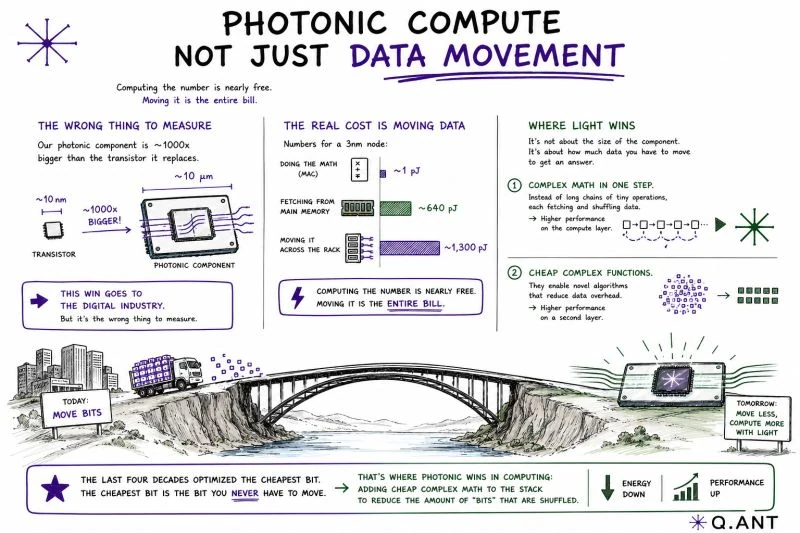
The photonic component we compute with is a thousand times bigger than the transistor it replaces. So why do we win?
 Dr. Michael FörtschFounder and CEO, Q.ANT
The sharpest pushback I get came under a post last week: our optical parts are enormous next to a transistor, and physics won’t let them shrink. So how can we possibly compete?
To be clear: on that point, the win goes to the digital industry. No argument. It’s just the wrong thing to measure.
Simple math got cheap
A modern AI chip does the same fundamental math as a chip from the 1970s: multiply and accumulate. What changed is how much of that simple math we can squeeze into the same area.
But simple math needs enormous amounts of data to describe complex problems, and data is the expensive part. The numbers, for a leading-edge node:
Where light wins
So the question isn’t “is this optical part cheaper than a transistor?” It’s “how much data do I have to move to get an answer?” And that’s where light wins, on two layers:
Complex math in one step. Light computes complex math in a single step, instead of long chains of tiny operations that each fetch and shuffle data. That lifts performance at the compute layer.
Cheap complex functions. They open the door to new algorithms that need less data in the first place: a second layer of gain on top.
The industry spent four decades optimizing what has become the cheapest bit in the stack. But the cheapest bit is the one you never have to move.
That’s where photonics wins: it adds cheap, complex math to the stack to cut how many bits get shuffled at all. Energy down, performance up.