






Photonic computing, built into your stack

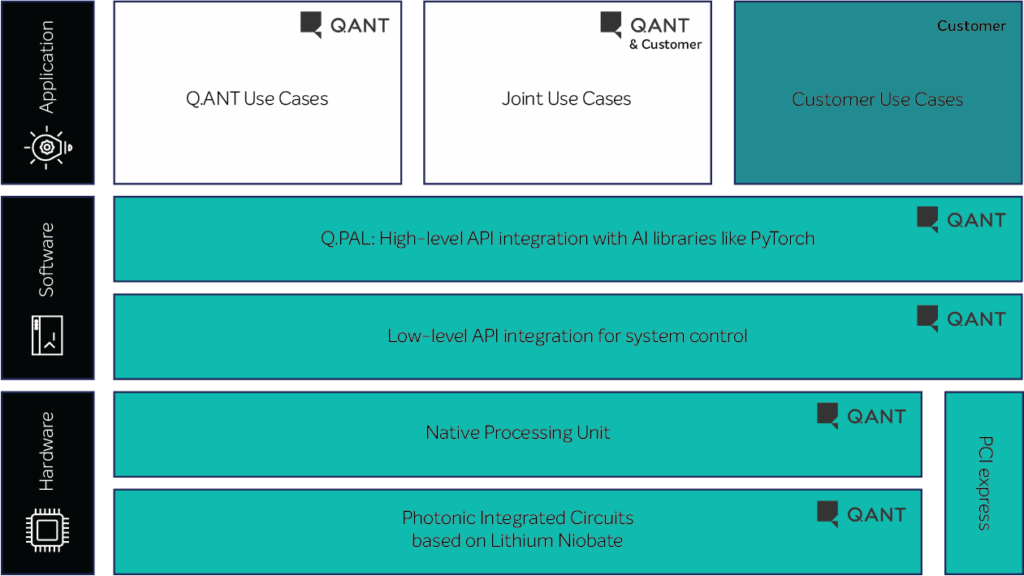
Access the NPS through the Q.ANT Photonic Algorithms Library (Q.PAL), C/C++ and Python APIs, and frameworks like PyTorch. 

A platform powered by light

Q.ANT software turns photonic computing into real applications. On a platform powered by light, complex mathematical models run with exceptional performance. From AI training and inference and machine learning to physics simulations and time-series analysis. The Q.ANT Photonic Algorithms Library (Q.PAL) is your interface to the NPU: with a comprehensive collection of example applications to build on. Because photonic processors are the natural fit for large-scale nonlinear networks, your models need fewer parameters and achieve higher.

Q.ANT NPS – The choice for efficient nonlinear networks

Q.ANT’s Native Processing Server executes demanding AI workloads directly in light. While CMOS processors excel at linear, sequential processing, photonic processors are the natural hardware fit for large-scale nonlinear algorithms. Networks with nonlinear functions reduce the number of model parameters needed allowing higher accuracy per parameter and training budget. In photonic processors one single optical element performs one nonlinear operation while CMOS requires 100-1000 transistors and multiple cycles.

In this example, a network using learnable nonlinear functions on Q.ANT‘s NPS reconstructs complex image patterns more accurately than a linear network on a CPU while 2x less parameters and 3x less operations are needed.

Original Image

Linear network on CPU

# parameters: ~20k
# operations: ~670m

Nonlinear network on NPU

# parameters: ~10k
# operations: ~250m

Whitepaper: Exploring Early AI Applications with Utz Bacher, VP Software

Exploring Early AI Applications on Q.ANT's photonic Native Processing Servers

The path from Digit Recognition to Image Learning

Learn More

Photonic Computing unlocks new performance levels for essential applications in AI and HPC

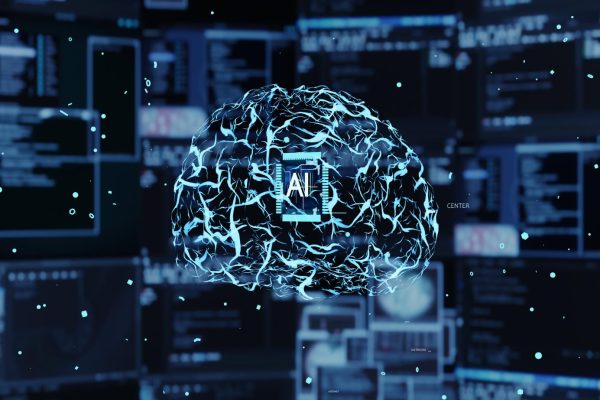
AI inference and training

Photonic Computing enables faster execution of matrix operations and non-linear functions directly in hardware. This allows for more efficient model architectures with fewer parameters. The result: higher throughput and lower power consumption for both, training large-scale models and real-time inference.

artificial intelligence,AI chat bot concept.Hands holding mobile phone on blurred urban city as background

Large Language Models (like GPT)

3D rendering of Reinforcement Learning

Reinforcement Learning

Advanced image processing

Many image processing tasks are inherently mathematical relying heavily on transforms like Fourier or convolution operations. With photonic processors, these operations can be performed optically, in parallel and at the speed of light. This dramatically increases frame rates and lowers energy usage.

Autonomous Self-Driving Cars Using Sensing System and Wireless Communication Network on Curved Highway at Dusk, Smart Traffic Technology, Driverless Vehicles, Evening Urban Road

Computer Vision

Real_time_video_analytics

Real-Time Video Analytics

Physics and scientific simulations

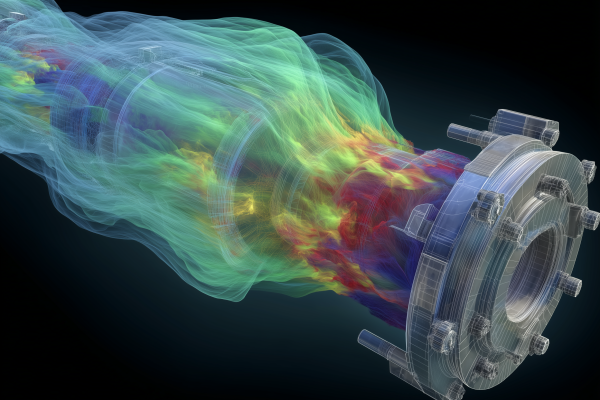
Scientific simulations often depend on solving complex partial differential equations and large-scale matrix systems. Photonic hardware provides a powerful platform for these workloads by enabling high-bandwidth, computing that scales with problem complexity, helping simulate physical phenomena faster and with greater efficiency.

quadix_Computational_fluid_dynamics_simulation_3D_scientific_vi_738ac7c0-4003-463d-9683-f47b33a533cc

Computational Fluid Dynamics

universal_upscale_0_48d8b3e3-c93f-42aa-9399-8b14650dfdc4_0

Molecular Dynamics

The Q.ANT Photonic Algorithms Library (Q.PAL)

The Q.ANT Photonic Algorithms Library (Q.PAL) is the software interface to the NPS which enables users to operate directly at the multiplication level or to leverage optimized neural network operations such as fully connected layers or convolutional layers. Q.PAL offers a comprehensive collection of example applications that illustrate how AI applications can be enhanced. These examples can be implemented directly or as a foundation for creating custom use cases.


NameDescriptionProgramming Language
Matrix MultiplicationMultiplication of a matrix and a vectorPython / C++
Image ClassificationClassification of an image (e.g. based on the ImageNet data set)Python (Jupyter)
Semantic SegmentationSegmentation of an image (e.g. based on a brain MRI scan data set)Python (Jupyter)
Complex Line FittingFitting of a high frequency line with a nonlinear network
(e.g. based on simulated training data)
Python (Jupyter)

Q.ANT integrates into the established compute landscape

Q.ANT’s photonic processing solution seamlessly integrates into the existing compute landscape. The Native Processing Unit at the heart of the NPS provides a PCIe interface housed in a standard 19” server, which makes the system plug-and-play. The NPU can be accessed via a software interface with C/C++ and Python APIs and will integrate into common AI frameworks such as PyTorch. Q.ANT supports customers in creating custom applications, providing the Q.ANT Photonic Algorithms Library and training resources.

Your contact

Utz Bacher Portrait 2.jpg

Utz Bacher

VP Software

I look forward to discussing the potentials of Photonic Computing with you.